Manufacturing & regulation
What are GMP peptides? What the label does and doesn't tell you
"GMP peptide" is a claim about how something was manufactured, not a result you can verify by reading a listing. Here's what GMP and GLP actually regulate, and what a lab report can tell you instead.
For research use only. VendorVerify sells nothing and takes no money from vendors. No affiliate links, no coupon codes, no paid rankings. How scores work
Key facts
- In the United States, current good manufacturing practice for finished drugs is set out in 21 CFR Parts 210 and 211, not in any test on a certificate of analysis.
- Under 21 CFR 210.1, failing to comply with these good manufacturing practice regulations renders a drug adulterated and subject to FDA regulatory action.
- ICH Q7, which FDA has adopted as guidance, covers good manufacturing practice for active pharmaceutical ingredients and applies to sterile APIs only up to the point immediately before sterilization.
- Good laboratory practice, under 21 CFR Part 58, governs nonclinical laboratory studies supporting FDA applications and says nothing about how a compound is manufactured.
- FDA has warned about unapproved drug products falsely labeled for research purposes or not for human consumption that are in fact sold to consumers for personal use.
GMP stands for good manufacturing practice — in the U.S., "current good manufacturing practice," or cGMP. It's a body of federal regulation that governs how a drug or its active ingredient is manufactured, documented, and quality-checked, not a claim you can confirm by reading a product listing or a certificate of analysis. When a research-labeled peptide listing says "GMP" or "GMP-grade," that's a manufacturing claim about a facility and a process — and a listing, by itself, isn't something you or we can verify it against.
This article covers what GMP actually regulates, how it differs from GLP (a different set of rules entirely, for laboratory studies rather than manufacturing), and what a buyer-commissioned lab report can and can't confirm about either one. None of this is legal advice.
What GMP actually is
In the United States, cGMP for drugs is set out in Title 21 of the Code of Federal Regulations, Parts 210 and 211. Part 210 states the scope plainly: those regulations, along with related parts, "contain the minimum current good manufacturing practice for methods to be used in, and the facilities or controls to be used for, the manufacture, processing, packing, or holding of a drug" to assure it meets the Federal Food, Drug, and Cosmetic Act's standards for safety, identity, strength, quality, and purity (21 CFR 210.1). Failing to comply doesn't just mean a paperwork gap — it means the drug is legally adulterated, which is the trigger for FDA enforcement action.
Part 211 is the longer, more granular half: it covers personnel qualifications, building and facility controls, equipment, component and container controls, production and process controls, laboratory controls, packaging and labeling, and recordkeeping for finished pharmaceuticals. Read together, Parts 210 and 211 describe a documented quality system — not a single test, and not a one-time inspection, but an ongoing set of controls that a facility either has in place or doesn't.
Two things follow from that. First, GMP is a property of a manufacturing operation over time, not of an individual vial. Second, verifying it requires access to the manufacturer's facility, batch records, and quality system — things a buyer reading a product page or a lab report has no way to see.
ICH Q7: GMP for the ingredient, not just the finished product
Parts 210 and 211 are written for finished drug products. For the active ingredient itself — the compound that goes into that finished product — the harmonized international standard is ICH Q7, "Good Manufacturing Practice Guidance for Active Pharmaceutical Ingredients," developed by the International Council for Harmonisation and adopted by FDA as guidance for industry. It applies to active pharmaceutical ingredients (APIs) manufactured by chemical synthesis, extraction, cell culture, fermentation, recovery from natural sources, or a combination of those routes, and it runs from the point a defined starting material enters the process through synthesis, purification, physical processing, and packaging of the finished API. It doesn't cover the earlier steps of making that starting material, and for sterile APIs it stops immediately before the sterilization step itself, according to summaries of the guidance from regulatory-compliance references including the ECA Academy and FDA's own guidance index. Practically, this means a peptide intended for use in an approved drug product is expected to be made under GMP twice over: once as the API, under Q7-aligned controls, and again when it's formulated into the finished product, under Part 211.
What a "GMP peptide" listing means — and doesn't mean
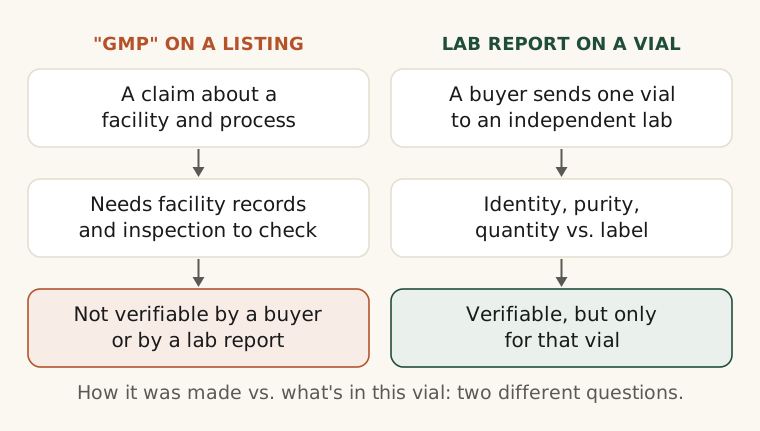
In practice, when a research-labeled peptide listing advertises "GMP" or "GMP-grade," it's asserting that the material was made in a facility operating under one of these frameworks. That's a real, checkable thing in principle. It is not something a buyer can check from the listing itself, and it is not something a certificate of analysis can confirm either.
Here's the gap in plain terms: a lab report describes what a specific vial contained when it was tested — identity, purity, quantity against label, sometimes endotoxin or sterility. It says nothing about the facility that made it, the quality system that facility runs, or whether that system has ever been audited or inspected against Part 211 or ICH Q7. A vial can test as 99.8% pure and still have come from a facility with no GMP oversight at all — purity and quality-system compliance are different things, measured in completely different ways. Conversely, a claim of GMP manufacturing tells you nothing about what's actually in a given vial unless it's paired with its own testing.
FDA has been explicit that labeling alone doesn't settle how a product is regulated. It warns about products "falsely labeled 'for research purposes' or 'not for human consumption'" that are in fact sold to consumers for personal use (FDA, "FDA's concerns with unapproved GLP-1 drugs used for weight loss"), and legal coverage of its 2025 warning letters describes the agency looking at the whole marketing context, not just the disclaimer (Health Law Alliance). The same logic applies in reverse to unverifiable manufacturing claims: a word on a product page isn't evidence of what happens inside a facility, and neither we nor a buyer can audit a GMP claim the way FDA itself can.
This is why the buyer-commissioned lab reports we publish don't attempt to confirm GMP status, and why an article like this one can't tell you which research-market sellers are and aren't operating under it. What a report can tell you is what actually got measured in the vial you're looking at — which is a narrower, but checkable, question.
GLP is a different thing entirely
GLP — good laboratory practice — gets confused with GMP constantly, partly because the acronyms are one letter apart and partly because both show up on research-peptide marketing. They regulate completely different activities.
GLP, under 21 CFR Part 58, governs how nonclinical laboratory studies are conducted — the safety and toxicology studies run on animals or in vitro to support a research or marketing application to FDA. The regulation's scope section says it applies to "nonclinical laboratory studies that support or are intended to support applications for research or marketing permits" for FDA-regulated products, including human and animal drugs, medical devices, biological products, and food and color additives. Part 58 covers things like study protocols, record-keeping, test facility organization, and quality assurance for the study itself — not how a chemical compound is manufactured.
So GMP is about how a drug or its ingredient is made. GLP is about how a nonclinical safety study is run. If a listing uses "GLP" as if it were a quality grade for the material itself, that's a misuse of the term: GLP describes how a study was conducted, not how a compound was made.
GMP vs. GLP at a glance
| GMP (cGMP) | GLP | |
|---|---|---|
| What it regulates | Manufacturing of drugs and active ingredients | Conduct of nonclinical (e.g., toxicology) laboratory studies |
| U.S. regulation | 21 CFR Parts 210–211 (finished drugs); ICH Q7 for APIs | 21 CFR Part 58 |
| Applies to | Manufacturing facilities and their quality systems | Test facilities running safety/toxicology studies |
| Typical question it answers | Was this batch made under documented, controlled, inspectable conditions? | Was this safety study conducted and recorded to a standard FDA can rely on? |
| Verifiable from a lab report? | No — a report describes the vial, not the facility | No — a report describes the vial, not the study |
| Verifiable from a listing? | No | No |
What actually is verifiable: the lab report
None of this means GMP and GLP don't matter — they matter enormously for anything intended as an actual pharmaceutical. It means they answer a different question than the one a buyer-commissioned lab report answers, and conflating the two leads to false confidence either way.
A certificate of analysis from an independent lab can tell you, for the specific vial tested: whether the material is identifiably the peptide it claims to be, how pure it is, how much is actually in the vial relative to the label, and — if ordered — results like endotoxin or sterility. It cannot tell you where the material was made, under what quality system, or whether a regulator has ever inspected that facility. And a report is only as trustworthy as the lab that produced it and the chain of custody around the sample — which is exactly why fake and altered COAs are a real problem in this market, independent of any GMP claim on the label.
We don't test anything ourselves. Every result on VendorVerify comes from an independent lab's report, mostly ones buyers commissioned and submitted to us, and we publish it against the vendor it came from. If a listing tells you its peptide is "GMP," the closest thing to independent evidence you have is still a lab report on that specific vial — not the word on the page. You can see what's been reported for a given vendor on our vendor ratings, read our methodology for how we score results, or submit a report of your own.
This isn't legal advice. Regulatory statements above are drawn from the cited federal regulations, ICH guidance, and FDA materials as of September 28, 2026.
Frequently asked questions
What are GMP peptides?
"GMP peptide" refers to a peptide manufactured under good manufacturing practice — a set of U.S. regulations (21 CFR Parts 210 and 211) and international guidance (ICH Q7 for active ingredients) that govern how a drug or its ingredient is made, documented, and quality-controlled. It's a claim about the manufacturing facility and process, not something a buyer can verify from a product listing, and it's a different thing from a lab report on a specific vial.
What does GMP mean for peptides?
For a peptide intended for use in an approved drug, GMP means the active ingredient was made under ICH Q7-aligned controls and the finished product under 21 CFR Part 211 — covering facility conditions, equipment, documented procedures, and quality oversight throughout manufacturing. For a research-labeled peptide listing, a GMP claim is unverifiable from the listing alone; it would require access to the manufacturer's facility and records to confirm.
How is GMP different from GLP?
GMP (21 CFR Parts 210–211, and ICH Q7 for active ingredients) regulates how a drug or its ingredient is manufactured. GLP (21 CFR Part 58) regulates how nonclinical laboratory studies, such as animal toxicology studies, are conducted and recorded to support an FDA application. They cover entirely different activities: one is about making a product, the other is about running a safety study.
Can a lab report confirm that a peptide is GMP-manufactured?
No. A certificate of analysis describes what a specific vial contained when it was tested — identity, purity, quantity versus label, and sometimes endotoxin or sterility. It says nothing about the facility that manufactured it or whether that facility operates under a documented GMP quality system, which can only be confirmed through facility records and regulatory inspection.
Is a research-use-only peptide the same as a GMP pharmaceutical ingredient?
Not necessarily, and the research-use-only label doesn't settle the question either way. FDA warns about products falsely labeled "for research purposes" that are in fact sold for personal use, and separately, a GMP claim on a listing is not something FDA, a buyer, or an independent lab report can confirm without access to the manufacturer's own facility and quality records.
Why doesn't VendorVerify report on which vendors use GMP manufacturing?
Because we only publish what an independent lab report actually measured in a tested vial — identity, purity, quantity, and similar results. A GMP claim describes a facility's manufacturing process and quality system, which isn't something a certificate of analysis tests for or something we're able to verify independently.