Manufacturing & regulation
What is an API for peptides? Active ingredient, explained
API means active pharmaceutical ingredient — the substance itself, before it's formulated into a finished drug. Here's what that means for a peptide, and how it compares with a single buyer-commissioned lab report.

For research use only. VendorVerify sells nothing and takes no money from vendors. No affiliate links, no coupon codes, no paid rankings. How scores work
Key facts
- Under 21 CFR 314.3, an active ingredient is any component intended to furnish pharmacological activity or other direct effect in diagnosing, curing, mitigating, treating or preventing disease.
- FDA's regulation defines a drug substance as an active ingredient but excludes the intermediates used in synthesizing it (21 CFR 314.3).
- A Drug Master File, under 21 CFR 314.420, is a confidential submission to FDA that its holder can authorize other companies to rely on without disclosing it.
- Under 21 CFR 314.420, FDA ordinarily neither independently reviews nor approves a Drug Master File and reviews its information only in the context of a specific application.
API stands for active pharmaceutical ingredient — the substance in a drug that actually produces its effect, as distinct from the finished, formulated product a patient or a research buyer ends up with. For a peptide, the API is the peptide molecule itself: a defined amino acid sequence, at a defined level of purity, made and tested to a specification before it goes anywhere near a finished dose form. Understanding what an API is — and what regulated manufacturing requires it to be tested for — makes it easier to see exactly how much or how little a single lab report on a research vial can tell you.
This article explains the API concept, how it differs from a finished drug product, what a peptide API is tested for at release under regulated manufacturing, and what Drug Master Files are. None of it is legal advice, and none of it is about dosing, use, or how to obtain any specific product.
Active ingredient vs. finished drug product
FDA's own definition, in the regulations governing new drug applications, is broad: an "active ingredient" is "any component that is intended to furnish pharmacological activity or other direct effect in the diagnosis, cure, mitigation, treatment, or prevention of disease, or to affect the structure or any function of the body," including components that undergo chemical change during manufacturing and end up in the drug product in a modified form (21 CFR 314.3). A related term, "drug substance," is defined the same way but explicitly excludes intermediates used along the way to making that ingredient.
A finished drug product is a different thing: the API combined with excipients (fillers, stabilizers, preservatives), formulated into the actual dose form — a vial, a pre-filled pen, a tablet — that reaches a patient or end user. The API is the ingredient; the finished product is everything built around it to make it deliverable and stable. Manufacturing a peptide API and manufacturing a finished peptide drug product are, formally, two separate regulated activities, each with its own set of good manufacturing practice expectations: ICH Q7 for the API, and 21 CFR Part 211 for the finished product. See our companion article on GMP for peptides for how those two frameworks relate.
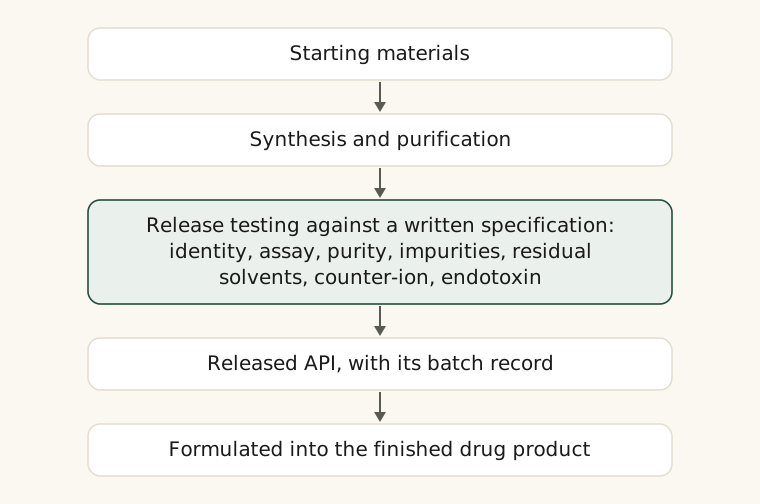
How a peptide API is specified and tested at release
In regulated pharmaceutical manufacturing, an API doesn't just get made and shipped — it gets tested against a written specification before each batch is released, and that specification is itself something a regulator can review. The internationally harmonized framework for what belongs in a specification is ICH Q6A, which distinguishes "universal" tests that apply to essentially every drug substance from tests that are added case by case depending on the specific molecule. For a peptide API, the tests that typically appear at release include:
- Identity — confirming the substance is, in fact, the intended peptide sequence, typically through methods like mass spectrometry or amino acid analysis, not just a color or solubility check.
- Assay (potency/content) — how much of the labeled substance is actually present, usually expressed as a percentage.
- Purity — most commonly measured by HPLC, expressing what fraction of the material is the target peptide versus everything else in the vial.
- Related substances / impurities — individual and total impurity peaks, including deletion sequences and other synthesis byproducts specific to peptide chemistry, each held to a limit justified by manufacturing and stability data.
- Residual solvents — solvents used during synthesis and purification that could remain in the final material; ICH Q3C, adopted by FDA as guidance, groups solvents into three risk-based classes and recommends acceptable limits for each.
- Counter-ion content — many synthetic peptides are isolated as a salt, commonly with trifluoroacetic acid (TFA) or acetate as the counter-ion; the specification defines and limits how much of that counter-ion is present, since it affects both the measured purity and the properties of the final material.
- Endotoxin — for APIs intended for injectable or otherwise parenteral use, endotoxin (a bacterial byproduct measured in endotoxin units) is tested against a limit tied to the intended route and dose of the finished product.
- Microbial/sterility attributes, water content, and other tests added depending on the specific peptide and its intended use.
Every one of these is a defined test method with a defined acceptance range, applied to every batch before it's released — not a one-off measurement on a single sample chosen after the fact.
Why counter-ion content isn't a footnote
The counter-ion point is worth dwelling on for a moment, because it quietly affects numbers buyers see on lab reports too. Many synthetic peptides come out of purification as a salt — the peptide bound to a counter-ion, most often trifluoroacetic acid (TFA) or acetate — rather than as the free peptide alone. That counter-ion has its own mass, and it's part of what a vial's total weight and, depending on the analytical method, its purity percentage actually reflect. A regulated API specification defines and limits counter-ion content explicitly, precisely because it isn't a side detail; it's part of what "how much peptide is really in here" means. A lab report that doesn't test for or disclose counter-ion form and content is silent on a variable that a full API specification treats as core, not optional.
Drug Master Files: how an API maker shares data without disclosing everything
A peptide API is very often made by one company and used by a different company to formulate the finished drug. That creates an obvious tension: the finished-product manufacturer's regulatory submission needs to describe the API's manufacturing and controls in detail, but the API manufacturer may not want to hand its proprietary process information directly to a business partner or competitor.
FDA's mechanism for resolving that is the Drug Master File, or DMF, described in 21 CFR 314.420. A DMF is a submission made directly to FDA by the party who holds the information — often the API manufacturer — for one of two purposes: to let that holder reference its own information in a future submission, or to authorize a different company (the finished-product applicant) to have FDA rely on that confidential information without the API manufacturer disclosing it to that company directly. In practice, this means the finished-product company that formulates the API only needs a letter of authorization to reference the file, not the underlying process details themselves. FDA doesn't ordinarily review a DMF on its own; it reviews the information in the context of the application that references it.
What a single buyer-commissioned lab report is — and isn't
All of the above describes a regulated API: a defined substance, made under GMP, tested against a written specification covering identity, assay, purity, impurities, residual solvents, counter-ion, and — where relevant — endotoxin, with every batch checked before release and the whole system open to inspection.
A lab report a buyer commissions on a single research-labeled vial is something much narrower. It typically covers a subset of that list — identity, purity, and quantity against label are the core three; endotoxin is common as an add-on; things like residual solvents, counter-ion content, or heavy metals show up far less often, simply because buyers don't always order them. Even when a report does cover several of these, it describes one vial, tested once, by one lab. It isn't a batch-release specification, it isn't repeated for every unit from that batch, and it doesn't tell you anything about the facility's quality system, its DMF status, or whether the material was ever specified the way a regulated API would be.
That gap is worth sitting with rather than glossing over. A vial that tests as high-purity and close to its labeled amount has genuinely been shown to contain what it claims, for that vial, that day. It has not been shown to have come from a facility running the kind of release-testing program described above, and it hasn't been checked for residual solvents or counter-ion content unless someone specifically paid for those tests. Endotoxin results in particular are inconsistent across the research market — measured in different units, on different bases, by different labs — which is exactly the kind of variability a regulated API specification is designed to eliminate.
Why the distinction matters for reading any peptide result
None of this is an argument that a lab report is worthless — it's the most concrete, checkable thing available for a research-market vial, and it's the entire basis of what we publish. The point is narrower: "API" and "GMP" describe a regulatory category and a manufacturing quality system, built around specifications, release testing, and Drug Master Files that a regulator can inspect. A single lab report describes a single vial. Knowing which question you're actually getting an answer to — "was this made and specified as a regulated API" versus "what did this specific vial measure" — is the difference between reading a report accurately and reading more into it than it says.
You can see what independent lab reports actually show for tested vendors on our vendor ratings, read how we score results, or submit a report of your own.
This isn't legal advice. Regulatory statements above are drawn from the cited federal regulations, ICH guidance, and FDA materials as of September 28, 2026.
Frequently asked questions
What is an API for peptides?
API stands for active pharmaceutical ingredient — the substance that actually produces a drug's effect, as distinct from the finished, formulated product built around it. For a peptide, the API is the peptide molecule itself, made and tested against a written specification before it's ever combined with other ingredients into a finished dose form.
What's the difference between an API and a finished drug product?
The API is the active ingredient alone. The finished drug product is that ingredient combined with excipients like stabilizers or preservatives and formulated into the actual dose form a user receives, such as a vial or a pre-filled pen. Regulated manufacturing treats making the API and making the finished product as two separate activities, each with its own good manufacturing practice framework.
What tests does a peptide API go through before release?
Under the internationally harmonized ICH Q6A framework, a regulated peptide API is typically tested for identity, assay (content), purity, related substances/impurities, residual solvents, and counter-ion content (commonly TFA or acetate), plus endotoxin where the API is intended for injectable use. Each test has a written acceptance range, and every batch is checked against it before release.
What is a Drug Master File?
A Drug Master File, or DMF, is a confidential submission made directly to FDA, usually by an API manufacturer, describing how that API is made and controlled. It lets a different company that uses the API in a finished drug product reference that information in its own FDA submission without the API manufacturer having to disclose its proprietary process details to that company directly.
Does a lab report show the same things a regulated API specification does?
Not usually. A buyer-commissioned lab report on a research vial typically covers a subset of what a regulated API specification requires — often identity, purity, and quantity versus label, sometimes endotoxin. It describes one vial tested once by one lab; it isn't a repeated batch-release test and doesn't confirm anything about the manufacturing facility's quality system or Drug Master File status.
Is a research-labeled peptide the same quality as a regulated API?
There's no way to confirm that from a listing or even from a single lab report. A regulated API is made under a documented quality system and tested against a full specification for every batch; a research-labeled vial's lab report describes what that specific vial measured on the day it was tested, which is a narrower and different kind of evidence.