Market & safety
What peptide company does Joe Rogan use?
A podcast mention tells you nothing about what's in a vial. Here's what's actually verifiable about Joe Rogan and BPC-157, and how to check a vendor's lab record instead of chasing a celebrity rumor.
For research use only. VendorVerify sells nothing and takes no money from vendors. No affiliate links, no coupon codes, no paid rankings. How scores work
Key facts
- VendorVerify found no dated primary source in which Joe Rogan names a specific peptide company as the one he personally uses.
- An Associated Press story dated November 14, 2025 reported that Joe Rogan is among the celebrity clients listed on one Texas company's website that offers peptides.
- Psychology Today reported in August 2026 that Joe Rogan has mentioned BPC-157 in no fewer than 31 podcast episodes.
- On April 15, 2026, FDA announced it would remove BPC-157 and eleven other peptides from Category 2 of its interim bulk drug substances list, which is not approval.
- FDA's Pharmacy Compounding Advisory Committee voted at its July 23-24, 2026 meeting to recommend adding BPC-157 and five other peptides to the 503A bulks list, a non-binding recommendation.
- BPC-157 has never been approved by FDA as a drug for any indication, and as of September 30, 2026, VendorVerify has logged lab reports on 41 BPC-157 vials.
No verified source has Joe Rogan naming a specific peptide company as the one he uses. What's documented is narrower: he's talked about the compound BPC-157 on his podcast for years, and an Associated Press story reported he's listed as a celebrity client on one clinic's website. Search "Joe Rogan peptide company" and you'll land on affiliate sites claiming to know exactly which vials he buys; none of them is a primary source. Here's what's actually verifiable, and a faster way to answer the question you probably actually have.
What's documented
The most concrete, sourced connection between Rogan and a named company comes from Associated Press health reporter Matthew Perrone, in a November 14, 2025 wire story on the peptide boom (republished by ABC7 Chicago and other AP affiliates), which reported that Rogan is among the celebrity clients listed on the website of a Texas-based company offering peptides, stem cells, vitamin infusions and other alternative treatments (AP/ABC7, Nov. 14, 2025). That's a client-listing fact, not an endorsement, and the report doesn't claim otherwise. We haven't evaluated that company and nothing here is a recommendation.
The same story quotes Rogan directly: "I had tendonitis in my elbow, I started using BPC-157 and it was gone in two weeks." That's a real, dated quote about a compound, not a company. A Psychology Today piece from August 2026 puts the pattern in perspective: Rogan has mentioned BPC-157 in no fewer than 31 episodes. Beyond that client listing, we found no dated primary source — episode, transcript, or on-the-record statement — naming any other specific brand as the one he personally uses. A seller doesn't need Rogan to say their name to benefit from it: they just need him to have said "BPC-157" often enough that a "Joe Rogan peptides" search has real volume, and then show up in the results with a product page. That's the gap where most of what you'll find online is actually built — years of genuine discussion about a compound, stretched by marketing into an implied brand endorsement that no source backs up.
Why it wouldn't matter anyway
Even in a world where a celebrity had specifically named a brand on air, that still wouldn't tell you anything about the purity or dose accuracy of a given vial from that brand. A podcast mention isn't a lab result — it doesn't test identity, purity, or how much of the labeled peptide is actually in a vial versus filler, degradation products, or nothing at all. Two vials sold under the same brand name, even from the same listing, can differ; that's not speculation, it's the entire reason independent, buyer-commissioned lab testing exists as its own category, separate from anything a celebrity says or a website claims. "A famous person likes this compound" and "this vendor's vials measure what the label says" are unrelated claims, checked by completely different kinds of evidence. Marketing conflates them on purpose, because a celebrity name is free and a clean lab report is not — which is why a seller's "as seen on Joe Rogan" claim is worth treating the same way you'd treat "doctor recommended" on a supplement bottle: as marketing, until it's traceable to a primary source.
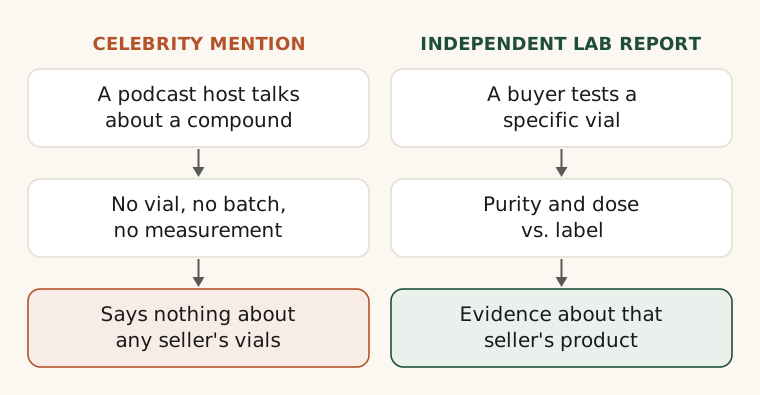
Find a BPC-157 vendor with an actual lab record instead
Skip the celebrity question and ask the one that's answerable: which vendors have independent lab reports, mostly commissioned by real buyers, showing what's actually in their BPC-157 vials? Here's how the ranked BPC-157 vendors look right now, verdicts and warning flags included:
Highest-ranked BPC-157 vendors right now
Live from independent lab reports, mostly paid for by buyers. Only vendors with 5+ reports are ranked. Updates as new reports come in.
| # | Vendor | Verdict | Score | Failed vials | Lab reports | Dose vs label |
|---|---|---|---|---|---|---|
| 1 | SRY | Below marketFailed vials | 77.5 | 16.7% | 6 | +39.0% |
A strong record describes vials people tested, not a guarantee for yours. Test your own vial when you can.
All BPC-157 resultsBPC-157 is thinner ground than tirzepatide or retatrutide in our data — we've logged reports on 41 BPC-157 vials so far, so that table may be short, or empty; a vendor needs 5+ lab reports before we rank it, and BPC-157 simply doesn't have as many buyers commissioning tests as the GLP-1 compounds do. Being ranked isn't the same as being good: read the verdict and the failed-vial rate, and treat a red flag as a reason to look elsewhere or test before you trust. Thin data is a reason to look closer at a report, not skip the step.
A few things worth checking on any result before you weigh it:
- Who actually ran the test. A report from a known third-party lab is checkable against that lab's own records; a certificate the vendor generated itself isn't evidence of anything.
- How many reports, not just one. A single clean result tells you about one vial, one day. A real track record needs more than that, especially in a compound with as few reports on file as BPC-157.
- Purity and dose vs. label, together. A vial can be highly pure and still contain far less, or far more, than the label claims — those are separate measurements, and a report should give you both.
The full method is in how to judge a peptide supplier. If you already have a vial in hand, how to get a peptide tested walks through ordering identity and purity testing yourself. And why most "best vendor" lists are written by vendors covers the affiliate lists that show up right alongside the celebrity-brand rumors, and why a real lab record looks nothing like them.
If a report on a vial you bought ever comes back bad, the fix isn't a better celebrity rumor — it's stopping use of that batch, telling whatever group you found the vendor through, going back to the vendor with the report, and submitting it through our submission form so the next buyer isn't guessing either.
The regulatory story, separate from any of this
There's a real, dated regulatory history for BPC-157 that has nothing to do with Rogan. FDA placed it in Category 2 of its interim bulk drug substances list in 2023, flagging significant safety concerns and blocking licensed compounding pharmacies from using it. On April 15, 2026, FDA announced it would remove BPC-157, along with eleven other peptides, from Category 2 (Frier Levitt, Apr. 16, 2026). That removal isn't approval — it doesn't place BPC-157 on the "may compound" Category 1 list, and at its July 23–24, 2026 meeting FDA's Pharmacy Compounding Advisory Committee voted to recommend adding it, along with five other peptides, to the 503A bulks list pharmacies can compound from (NCPA, July 31, 2026). That vote is non-binding; the Secretary of Health and Human Services still has to approve it, and formal placement on the list would be a separate rulemaking step. BPC-157 has never been approved by FDA as a drug for any indication. None of that turns on whether any celebrity has used it — it's about whether licensed compounding pharmacies may legally prepare BPC-157 for patients, a different question from what's sold on a research-use-only storefront.
For what independent lab testing shows on this specific compound, see the BPC-157 results page. For sourcing evidence on any vendor's claims, see how to judge a peptide supplier and the live vendor ratings.
Database figures in this article update automatically from the lab results on VendorVerify. Figures given with a date are snapshots from Sep 28, 2026. The vendor and peptide pages show the full, latest data.
Frequently asked questions
What peptide company does Joe Rogan use?
No dated primary source has Joe Rogan naming a specific peptide vendor as the one he personally uses. The clearest documented connection is a November 2025 Associated Press story reporting that he's listed as a celebrity client on the website of a Texas-based company offering peptides and other alternative treatments — a client-listing fact, not an endorsement.
Has Joe Rogan endorsed a specific peptide brand?
Not that we could verify. He's spoken repeatedly and on the record about the compound BPC-157, describing his own results with it, but talking about a compound is different from endorsing the company that sells it. Any seller claiming Rogan endorses their specific brand is making a claim we could not verify.
Does Joe Rogan take BPC-157?
According to an Associated Press story, Rogan said on his podcast: "I had tendonitis in my elbow, I started using BPC-157 and it was gone in two weeks." That's a real, sourced quote about his own reported experience; it isn't a lab result and says nothing about the quality of any specific product sold under that name.
Does a celebrity mentioning a peptide mean it's a good product?
No. A public figure describing their own experience with a compound says nothing about whether a specific vendor's vial actually contains what its label claims. Purity and dose accuracy come only from independent lab testing of that product, not from podcast comments.
What does the FDA say about BPC-157?
FDA placed BPC-157 in Category 2 of its interim bulk substances list in 2023, a category reserved for significant safety concerns that blocks pharmacies from compounding it. FDA announced on April 15, 2026 that it would remove that flag, which isn't the same as approving it; BPC-157 has never been approved by FDA as a drug for any use, and its compounding status was still under advisory review as of mid-2026.
How do I actually find a good BPC-157 vendor?
Skip the celebrity angle and look at independent lab reports: how many a vendor has, how recent they are, and whether purity and dose-vs-label hold up across more than one test. BPC-157 has fewer lab reports in circulation than tirzepatide or retatrutide, so a vendor may not be ranked yet simply for lack of data — that's a reason to check closely, not a reason to trust a marketing claim instead.