Manufacturing & regulation
Who is the largest manufacturer of peptides? It depends what you're measuring
"Largest peptide manufacturer" means different things depending on whether you're asking about contract manufacturers, drugmakers, or raw material producers. Here's what's actually verifiable, by measure and by date.
For research use only. VendorVerify sells nothing and takes no money from vendors. No affiliate links, no coupon codes, no paid rankings. How scores work
Key facts
- Bachem, a Swiss peptide contract manufacturer, reported net sales of CHF 695.1 million for full-year 2025, up 14.8%, in its results release of March 12, 2026.
- PolyPeptide Group reported revenue of approximately EUR 389 million for full-year 2025 in its results release of January 19, 2026.
- Eli Lilly's tirzepatide drugs Mounjaro and Zepbound together brought in about $36.5 billion in 2025, out of total company revenue of about $65.2 billion.
- Novo Nordisk reported Ozempic sales of DKK 127,089 million for full-year 2025, up 6% in Danish kroner, in its 2025 annual report.
- CordenPharma does not disclose peptide revenue but announced on July 16, 2024 a sales target of about EUR 1 billion for its peptide platform by 2028.
It depends what "largest" means. By drug sales, the biggest peptide companies are Eli Lilly, whose tirzepatide drugs Mounjaro and Zepbound brought in about $36.5 billion in 2025, and Novo Nordisk, maker of the semaglutide drugs Ozempic and Wegovy. Among contract manufacturers that make peptide ingredients for drug companies and publish their revenue, Bachem reported the highest 2025 sales: net sales of CHF 695.1 million, up 14.8%. PolyPeptide Group reported about EUR 389 million. But "largest peptide manufacturer" isn't one ranking, because "largest" isn't one measurement. A company can lead by contract-manufacturing revenue, by sales of a branded peptide drug, or by raw-material volume, and those are three different lists with different companies at the top.
This piece pulls apart those three meanings, gives the verified, dated numbers behind each one, and is explicit about where the public record runs out. It has nothing to do with the vendors selling unregulated "research use only" peptide vials — we get into why at the end.
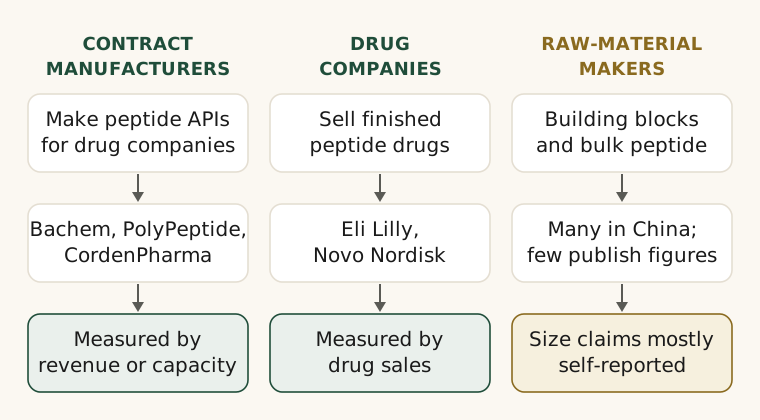
The three different things people mean by "largest"
1. Contract manufacturers (CDMOs) make peptide active pharmaceutical ingredients (APIs) to order, for pharmaceutical companies that then formulate, package, and sell the finished drug. Bachem, PolyPeptide Group, and CordenPharma are the names that come up most in this category. Their customers are drug companies, not consumers, and "largest" here usually means revenue or manufacturing capacity.
2. Companies selling the biggest peptide drugs don't necessarily make the most peptide, tonnage-wise — Eli Lilly and Novo Nordisk sell enormous volumes of tirzepatide and semaglutide respectively. "Largest" here means drug sales revenue, which is a commercial measure, not a manufacturing one.
3. Raw peptide and building-block producers, concentrated heavily in China, supply the amino-acid derivatives and bulk peptide material that other manufacturers, labs, and (separately) the unregulated research-chemical trade all draw from. Public financial data on this group is thinner, and self-reported market-share claims are common and mostly unverifiable from outside the company.
None of these three lists is "the" answer to who's biggest. Below is what's actually documented for each, with the date every figure is as of.
Largest peptide CDMOs, by verified revenue
Three names dominate this conversation in pharma trade coverage: Bachem (Switzerland), PolyPeptide Group (Switzerland), and CordenPharma (owned since 2022 by the private equity firm Astorg, with sites in the US and Europe). Here's what each has actually reported:
| Company | Reported revenue | Period | Source |
|---|---|---|---|
| Bachem | CHF 695.1 million (net sales), up 14.8% | Full year 2025 | Bachem full-year results release, 12 March 2026 |
| PolyPeptide Group | approx. EUR 389 million | Full year 2025 | PolyPeptide FY2025 results release, 19 January 2026 |
| CordenPharma | Not disclosed; the company announced a sales target of about €1 billion for its peptide platform by 2028, backed by long-term contracts it put at about €3 billion | Forward-looking target, announced 16 July 2024 | CordenPharma peptide platform investment release |
By reported revenue alone, Bachem's CHF 695.1 million for 2025 is larger than PolyPeptide's roughly EUR 389 million for the same year — but CordenPharma doesn't publish comparable figures, so we can't complete a three-way ranking. CordenPharma's own site describes its Colorado facility as running "the largest worldwide multi-ton peptide capacity available" — that's the company's own description of its production capacity, not an independently audited industry ranking, and it's a capacity claim, not a revenue claim. Worth noting too: revenue and manufacturing capacity aren't the same thing, and a company can lead on one without leading on the other.
If you're asking "which CDMO makes the most peptide API for drug companies," the honest answer as of today is: Bachem currently reports the highest revenue of the three that disclose figures, CordenPharma likely has comparable or larger physical capacity based on its own stated investment and contract totals, and there is no single independently verified ranking that puts all three on the same measuring stick.
Largest companies selling peptide drugs, by drug revenue
This is a completely different question, and a much easier one to answer with hard numbers, because Eli Lilly and Novo Nordisk are both public companies with audited, itemized financial disclosures.
Eli Lilly's tirzepatide products (Mounjaro, for type 2 diabetes, and Zepbound, for obesity) combined for about $36.5 billion in revenue in 2025, according to Lilly's fourth-quarter and full-year 2025 results, out of total company revenue of about $65.2 billion.
Novo Nordisk's semaglutide products (Ozempic, for type 2 diabetes, and Wegovy, for obesity) reported Ozempic sales of DKK 127,089 million for full-year 2025, up 6% in Danish kroner, per Novo Nordisk's 2025 annual report. Wegovy sits inside the company's broader "Obesity care" category, which totaled DKK 82,347 million for the year — Novo Nordisk doesn't break Wegovy out as a standalone line in that section, so we're citing the category total rather than guessing at a product-only figure. Novo Nordisk reports in Danish kroner, not U.S. dollars, so a direct comparison to Lilly's dollar figures requires a currency conversion we haven't made here; readers converting these figures themselves should use the same date's exchange rate for both.
What's clear without needing a currency conversion: both companies book tens of billions of dollars a year from a single peptide molecule each, and both are unambiguously the "largest" seller of their own drug, because each is the originator and manufacturer of record for its own branded product. (Semaglutide's core patent expired in India in March 2026 and generic versions launched there on March 21, 2026, so Novo Nordisk no longer has exclusivity in every market.) Whether Lilly's tirzepatide franchise or Novo Nordisk's semaglutide franchise is larger by revenue depends on the exchange rate used and the exact period compared, and we're not going to manufacture a number where the two companies' own reporting doesn't line up on the same basis.
Mounjaro and Zepbound and Ozempic and Wegovy are all FDA-approved prescription drugs. Neither company sells "research use only" peptides, and neither is relevant to the unregulated market discussed below.
Chinese peptide manufacturers, at scale — what's actually verifiable
This is the category where public data is thinnest and self-reported claims are most common, so we're going to be more careful here than anywhere else in this article.
Large Chinese manufacturers make peptide building blocks, bulk peptides and, in some cases, APIs for drug companies, but most don't publish peptide-specific revenue, and the market-share figures that circulate are usually companies' own marketing claims. We aren't naming individual Chinese manufacturers here, because we couldn't verify a comparable, independently sourced size figure for any of them.
Trade-press estimates about Chinese peptide API capacity as a whole — figures like "China will capture 40% of global peptide API supply by 2028" — circulate widely in industry blog posts and market-research summaries. We looked for the underlying primary data behind those figures and didn't find one we could verify to a specific, checkable source, so we're not repeating them as fact here. If you see a specific percentage cited elsewhere, ask what report it traces back to before treating it as established.
Why there's no sourced "top 5" list
Every claim above is tied to a specific company, a specific reporting period, and a specific source you can check yourself. Notice what's missing: a single ranked list with five companies in order. That's deliberate. Building a "top 5 peptide companies" list would require putting Bachem's CHF revenue, PolyPeptide's EUR revenue, CordenPharma's undisclosed figures, Lilly's dollar revenue, Novo Nordisk's kroner revenue, and unverifiable Chinese capacity estimates all on one ruler — and none of the public data actually supports doing that honestly. Anyone publishing a definitive "top 5" is either using a measure they haven't disclosed, or making numbers up. If you see one with no dates and no sources, that's the tell.
Why this doesn't tell you anything about grey-market vials
Nothing above has any bearing on the vials sold as "research use only" on the grey market — the tirzepatide, retatrutide, and BPC-157 products this site publishes lab data on. None of the companies named here (Bachem, PolyPeptide, CordenPharma, Eli Lilly, Novo Nordisk) sell into that channel as a matter of public record, and we have no evidence connecting any specific grey-market vendor's supply to any specific manufacturer named above. The grey market runs on a completely different, much less documented chain: a synthesis source (frequently, but not verifiably in any individual case, based in China), through one or more resellers, to an individual buyer, with no FDA oversight, no public financial disclosure, and no manufacturer accountable by name. We cover how that chain actually works in what are grey market peptides, and what's — and isn't — knowable about Chinese sourcing specifically for grey-market vendors in Chinese peptide vendors and independent testing.
Because nobody in the grey-market chain publishes an annual report, "who's the largest manufacturer" is not a question independent lab testing can answer either. What lab testing can tell you is what a specific vial actually contained when a specific lab tested it — which is a narrower, more honest question, and the one this site is built around. If you're trying to judge a specific seller rather than a specific manufacturer, how to judge a peptide supplier and the live vendor ratings are the tools for that; our methodology explains how those scores are built. For how legitimate drugmakers actually source their peptide API in the first place, see where do companies get their peptides from; for what's specifically manufactured in the US, see peptides manufactured in the USA.
Figures in this article are sourced to the companies' own financial disclosures and press releases, dated as cited; none are from the VendorVerify lab-report database.
Frequently asked questions
Who is the largest manufacturer of peptides?
There's no single answer, because it depends what you're measuring. By reported 2025 revenue, Bachem (CHF 695.1 million) reports more than PolyPeptide Group (about EUR 389 million) among peptide contract manufacturers, but CordenPharma doesn't disclose comparable figures. By peptide drug sales, Eli Lilly's tirzepatide products (Mounjaro and Zepbound) totaled about $36.5 billion in 2025, and Novo Nordisk's Ozempic alone reported DKK 127,089 million. Those are different categories measuring different things, not one ranking.
Who is the biggest manufacturer of peptides?
Same answer as "largest": it depends on the category. Among peptide contract manufacturers who disclose revenue, Bachem reported the highest 2025 figure (CHF 695.1 million) of the companies we could verify. Among companies selling peptide drugs, Eli Lilly and Novo Nordisk each report tens of billions of dollars a year from a single molecule, in different currencies that aren't directly comparable without a specific exchange-rate conversion.
What are the top 5 peptide companies?
We're not publishing a top-5 list, because doing so honestly would require comparing Bachem's Swiss franc revenue, PolyPeptide's euro revenue, CordenPharma's undisclosed figures, Eli Lilly's and Novo Nordisk's drug sales in different currencies, and unverifiable Chinese manufacturing-capacity estimates all on the same scale — and the public data doesn't support that. Any list you see presented as definitive without dates and sources for every entry should be treated skeptically.
Is Eli Lilly or Novo Nordisk the largest peptide drug company?
Both report enormous revenue from a single peptide drug each — Lilly's Mounjaro and Zepbound (tirzepatide) totaled about $36.5 billion in 2025, while Novo Nordisk's Ozempic (semaglutide) alone reported DKK 127,089 million the same year. Because Novo Nordisk reports in Danish kroner and Lilly in US dollars, a direct ranking requires a currency conversion at a specific exchange rate, which we haven't applied here rather than presenting an unsourced comparison.
Is Bachem or CordenPharma the largest peptide CDMO?
Bachem is the larger of the two by disclosed revenue — it reported CHF 695.1 million in net sales for 2025. CordenPharma doesn't publish comparable revenue figures; it has announced a target of about EUR 1 billion in peptide-platform sales by 2028 and describes its Colorado facility as having the largest multi-ton peptide production capacity available worldwide, which is the company's own description of its capacity, not an independently audited ranking.
Do the biggest peptide manufacturers supply the grey market?
We have no evidence connecting Bachem, PolyPeptide, CordenPharma, Eli Lilly, Novo Nordisk, or any other named manufacturer to a specific grey-market vendor's supply. The unregulated "research use only" peptide market runs through a separate, largely undocumented chain of synthesis sources and resellers, none of whom file the kind of public financial disclosures the companies in this article do.