Manufacturing & regulation
Which peptides are manufactured in the USA?
FDA-approved peptide drugs are made somewhere, but the manufacturing site usually isn't public per product. Here's what's actually documented about US peptide manufacturing, and why a label claim on a research vial isn't proof of origin.
For research use only. VendorVerify sells nothing and takes no money from vendors. No affiliate links, no coupon codes, no paid rankings. How scores work
Key facts
- EGRIFTA WR (tesamorelin F8) was approved by FDA on March 26, 2025, and trade coverage says it will be manufactured at a new U.S.-based contract manufacturer.
- CordenPharma announced in July 2024 that it would invest about EUR 900 million over three years in peptide manufacturing in the US and Europe, including a new Colorado facility.
- Since 2015, FDA has conducted more foreign than domestic drug inspections, according to the agency's June 2020 testimony to Congress.
- Until the 2012 FDASIA law, FDA was legally required to inspect US drug manufacturing facilities every two years but had no similar mandate for foreign facilities.
- A lab report measures identity, purity and quantity in a vial and cannot determine which country's factory made the peptide, so it cannot verify a made-in-USA claim.
FDA-approved peptide drugs such as Mounjaro, Zepbound, Ozempic, Wegovy and Egrifta are made under FDA oversight, but companies rarely publish which plant made which product, so for most of them the honest answer is "somewhere FDA inspects, not necessarily the US." A few US facts are documented: Egrifta WR's maker announced a US-based contract manufacturer for it, and CordenPharma is expanding a large peptide ingredient plant in Colorado. For research-labeled vials, "made in USA" is a claim no one checks, and a lab report can't confirm it.
"Made in the USA" is one of the most common claims stamped on research-peptide listings, and it's almost never something a buyer can verify. This article covers what's actually documented about US peptide manufacturing — for FDA-approved drugs and for one specific, named contract-manufacturing facility — and then addresses the label claim directly, because that's usually what people are really asking about.
FDA-approved peptide drugs: manufacturing happens somewhere, but the site usually isn't public per product
Several peptide drugs are FDA-approved and legally manufactured and sold in the US: tirzepatide (Mounjaro and Zepbound, Eli Lilly), semaglutide (Ozempic and Wegovy, Novo Nordisk), and tesamorelin (Egrifta, currently marketed by Theratechnologies) among them. Each of these has gone through FDA review, and each company operates under FDA oversight of its approved manufacturing sites.
What's not typically public, at the level of an individual buyer's curiosity, is exactly which facility made a specific batch of a specific drug. Companies disclose manufacturing locations to the FDA as part of their approved applications, and some information becomes public through FDA facility databases, SEC filings, or company statements about specific investments — but there isn't a simple, product-by-product "manufactured at this address" label the way you might expect from, say, a food product. A drug company may manufacture at more than one site, may use a mix of in-house and contracted capacity, and may not publicize the exact split. We're not going to guess at specifics we can't verify for a given drug; where we can point to something concrete and sourced, we do, below.
One drug where the manufacturing location was actually announced: EGRIFTA WR (tesamorelin F8), Theratechnologies' newer formulation of tesamorelin, approved by the FDA on March 26, 2025, according to reporting by Contract Pharma. That coverage states the product "will be manufactured at a new U.S.-based contract drug manufacturing organization (CDMO)." That's a specific, named, dated, sourced fact about a specific FDA-approved peptide drug's US manufacturing location — exactly the kind of claim this article is trying to surface, rather than a generic assurance that "American peptides are made here."
A specific, verifiable example: CordenPharma's Colorado peptide facility
One concrete, sourced fact we can point to: CordenPharma operates a large-scale peptide active pharmaceutical ingredient (API) manufacturing facility in Colorado, and the company has announced a major expansion there. Per CordenPharma's own press release, the company announced in July 2024 that it would invest about €900 million over three years in its peptide platform in the US and Europe, including a new large-scale manufacturing facility in Colorado and more manufacturing trains in its existing facility there.
That's a real, named, US-based peptide API manufacturing facility, expanding to supply GLP-1 peptide demand under long-term contracts CordenPharma says total around €3 billion. It's a contract manufacturer, though — CordenPharma makes peptide API for other pharmaceutical companies' branded drugs, under its clients' approvals, rather than selling a "CordenPharma-brand" peptide directly to consumers. We're citing it because it's one of the few specific, dated, sourced facts about US peptide manufacturing capacity that we could verify, not because it tells you where any particular drug on a pharmacy shelf, or any particular research vial, was made.
FDA oversight: foreign vs. domestic manufacturing sites
A related question people ask is whether the FDA treats foreign-made peptides differently from domestically made ones. The honest answer is: less differently than you might expect, at least in principle, though the history is uneven. FDA's 2020 testimony to Congress states that the agency "inspects drug manufacturing facilities located around the world with comparable depth and rigor based on an assessment of risk to public health."
In practice, the balance has shifted over time. Until the Food and Drug Administration Safety and Innovation Act (FDASIA) passed in 2012, FDA was legally required to inspect domestic facilities at least every two years, with no equivalent mandate for foreign facilities — a gap that, combined with resource constraints, meant domestic sites were inspected more consistently for years. Since 2015, foreign drug-manufacturing inspections have actually outnumbered domestic ones, according to FDA's own inspection data cited in congressional testimony, which also noted that FDA usually announces foreign surveillance inspections in advance but generally does not announce domestic ones. In May 2025, FDA announced it would expand unannounced inspections at foreign manufacturing facilities. The types of inspections — pre-approval, routine surveillance, and for-cause — are the same on both sides. None of this is a statement about any specific facility's compliance record today; it's the general regulatory framework, sourced to FDA's own materials, and it's not legal advice.
What this means practically: an FDA-approved drug manufactured overseas is still subject to FDA inspection, and a domestic manufacturing location is not, by itself, a guarantee of anything beyond that regulatory oversight applying. Location and quality assurance aren't the same claim. A drug made in a US facility and a drug made in an FDA-inspected foreign facility are both subject to the same approval standard, on paper; what's actually varied historically is inspection frequency and, at times, advance notice, not the standard being applied once an inspector is on-site.
That distinction is worth sitting with for a second, because it cuts against a common assumption: that "made in the USA" is, by itself, a proxy for "better regulated." For an FDA-approved drug, it isn't — the approval and inspection framework is meant to apply regardless of location, even if enforcement resourcing has historically leaned toward more frequent domestic checks. Where geography does matter more directly is in the unregulated research-vial market discussed below, precisely because there's no equivalent inspection regime for either domestic or foreign sellers in that channel — so a claim of US origin there isn't backed by the same system at all.
"Made in USA" on a research-labeled product: label claim vs. evidence
This is usually the real question behind the search: does a research vial that says "made in USA," or is sold by a US-based seller, actually contain US-manufactured material?
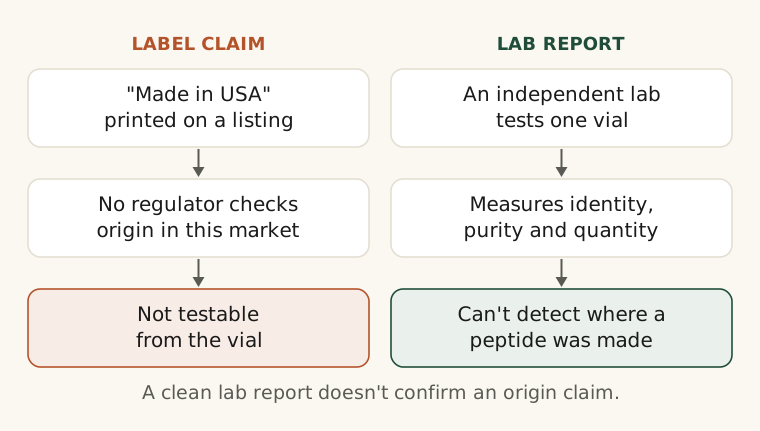
There's no regulatory body verifying country-of-origin claims on "research use only" peptide listings the way there is for an FDA-approved drug's manufacturing site. A seller can print "made in USA" on a label, a website, or a listing regardless of where the underlying peptide was actually synthesized, and — because this market has no mandatory country-of-origin auditing — nothing structurally stops that claim from being false. A US business address, US-based customer service, or US domestic shipping also isn't the same claim as US manufacturing; a seller can be a US company reselling material synthesized anywhere.
Here's the part that matters most, and it's the same limitation that runs through everything else on this site: a lab report tests what's in the vial, not where it came from. Purity, identity, and quantity results tell you whether the vial contains the peptide it claims, at roughly the amount claimed, at a stated purity. None of that is a test for geographic origin. A lab can't look at a purified peptide sample and determine which country's factory produced it — that information isn't chemically encoded in the molecule. So a clean lab report and a "made in USA" claim can both be true of the same vial without the lab report actually having verified the claim at all.
We go through what a certificate of analysis can and can't tell you, line by line, in how to read a peptide COA — worth reading in full if you're trying to evaluate a specific report. And because so much of this market's raw material discussion centers on China specifically, we cover what's actually known — and not known — about Chinese-origin claims and independent testing outcomes in Chinese peptide vendors and independent testing; the short version is that we don't have reliable, vendor-by-vendor origin data, and a testing result doesn't supply it.
What this means if you're trying to find a US-made peptide
If your question is about FDA-approved drugs, the honest answer is that they're legally manufactured under FDA oversight, but the specific facility behind any given batch usually isn't something an individual buyer can verify — that's a level of supply-chain detail companies don't typically publish per product. If your question is about a research-labeled vial claiming "made in USA," the honest answer is that the claim is unverifiable from the outside, a lab report can't confirm or deny it, and we're not aware of any mechanism in this unregulated market that would catch a false one. For a broader look at how peptide sourcing and manufacturing actually works — legitimate and otherwise — see where do companies get their peptides from and who's the largest peptide manufacturer. If you're evaluating a specific seller's claims against actual lab data, the live vendor ratings and our methodology are built for exactly that, based on lab reports buyers themselves commissioned.
This isn't legal advice. Regulatory statements above are sourced to FDA materials as cited; the CordenPharma facility details are sourced to the company's own press release and contemporaneous trade-press coverage, both linked inline.
Frequently asked questions
Which peptides are manufactured in the USA?
Several FDA-approved peptide drugs — including tirzepatide (Mounjaro, Zepbound), semaglutide (Ozempic, Wegovy), and tesamorelin (Egrifta) — are legally manufactured and sold in the US under FDA oversight, but the specific manufacturing facility behind a given batch usually isn't public information at the product level. One confirmed example: EGRIFTA WR (tesamorelin F8), FDA-approved in March 2025, was to be manufactured at a new U.S.-based CDMO, according to trade-press coverage of its approval. Another is CordenPharma's Colorado peptide API facility, part of a roughly €900 million peptide expansion the company announced in 2024.
Is there a real US peptide manufacturing facility that's been publicly confirmed?
Yes. CordenPharma operates a large-scale peptide API manufacturing facility in Colorado and announced in 2024 a roughly €900 million expansion of its peptide platform, including a new large-scale facility in Colorado, per the company's own press release. It's a contract manufacturer making API for other companies' drugs, not a consumer-facing peptide brand.
Does the FDA treat peptides made overseas differently from ones made in the USA?
FDA states it inspects drug manufacturing facilities worldwide with comparable depth and rigor based on risk, and uses the same inspection types (pre-approval, surveillance, for-cause) domestically and abroad. In practice, FDA was required to inspect US facilities every two years until a 2012 law (FDASIA) replaced that fixed interval with a risk-based schedule, and foreign inspections have outnumbered domestic ones since 2015. This is general FDA policy, not a statement about any specific facility.
Does "made in USA" on a research peptide vial mean it actually was?
Not necessarily. There's no regulatory verification of country-of-origin claims on research-labeled peptide listings, and a seller can print that claim regardless of where the material was actually synthesized. A US business address or US shipping also isn't the same as US manufacturing.
Can a lab report confirm where a peptide was manufactured?
No. A lab report measures identity, purity, and quantity — what's in the vial and roughly how much — not where it was made. Geographic origin isn't something a chemical analysis of a purified peptide sample can determine, so a clean lab report doesn't verify a "made in USA" or any other origin claim.
Are Chinese-made peptides lower quality than US-made ones?
We don't have vendor-by-vendor, verified origin data to make that comparison, and lab reports don't test for origin, so we can't answer that question from our data. What the lab reports in our database do show is purity, dose accuracy, and failure rates by compound and by vendor, regardless of claimed origin — see our vendor ratings for that comparison instead.
Where can I verify a peptide company's US manufacturing claims?
For FDA-approved drugs, the manufacturer's own investor disclosures, SEC filings, and FDA-facing regulatory submissions are the closest thing to a verifiable source, though facility-level detail per product often isn't public. For research-labeled products, we're not aware of a reliable way to verify a seller's origin claim from the outside, and a lab report can't do it either.