Manufacturing & regulation
Where do companies get their peptides from?
Drug companies don't just order peptide off a website. Here's the qualification and documentation chain that governs legitimate peptide sourcing, and how it differs from the grey market.
For research use only. VendorVerify sells nothing and takes no money from vendors. No affiliate links, no coupon codes, no paid rankings. How scores work
Key facts
- FDA has adopted ICH Q7 as its guidance on good manufacturing practice for active pharmaceutical ingredients, the category that includes peptide APIs made for drug companies.
- Peptide APIs for approved drugs are often made by contract manufacturers such as Bachem, PolyPeptide Group and CordenPharma rather than by the drug company named on the box.
- Under 21 CFR 314.420, a Drug Master File is a submission to FDA that lets its holder authorize other companies to rely on the information without disclosing it to them.
- A Drug Master File can contain information about a drug substance, a drug substance intermediate, or the materials used in their preparation, under 21 CFR 314.420.
Drug companies get their peptides from qualified manufacturers of the active ingredient: either their own plants or specialized contract manufacturers (CDMOs), which must follow good manufacturing practice and document every batch before the material is used in a medicine. Research institutions buy from research-chemical suppliers under research purchase terms. Legitimate "wholesale" peptide supply is a business-to-business arrangement between qualified parties, not a retail purchase. A pharmaceutical company doesn't source its peptide the way an individual buyer sources a research vial. There's no listing, no cart, no vendor DM. There's a qualification process that can take months to years, a paper trail that follows the material from raw amino acids to finished drug product, and a regulatory framework that makes the entire chain traceable back to a specific facility, a specific batch, and a specific set of test results — before a single gram reaches a patient.
This piece covers how that legitimate chain actually works, then answers the "wholesale" version of the question directly, since it comes up often.
The legitimate chain: from API manufacturer to finished drug
For an FDA-regulated drug, the peptide active pharmaceutical ingredient (API) — the actual peptide molecule, before it's formulated into a finished product — is often made by a specialized contract manufacturer, or CDMO (contract development and manufacturing organization), rather than by the company whose name ends up on the box. Bachem, PolyPeptide Group, and CordenPharma are three of the best-known peptide CDMOs; we cover what's actually verifiable about their scale in who's the largest peptide manufacturer. A drugmaker like Eli Lilly or Novo Nordisk may also manufacture some of its own peptide API in-house, in addition to contracting out capacity — both approaches are common, and a company's public disclosures don't always specify exactly which batch came from where.
Getting from "we need this peptide" to "we're using it in an approved drug" runs through several distinct steps:
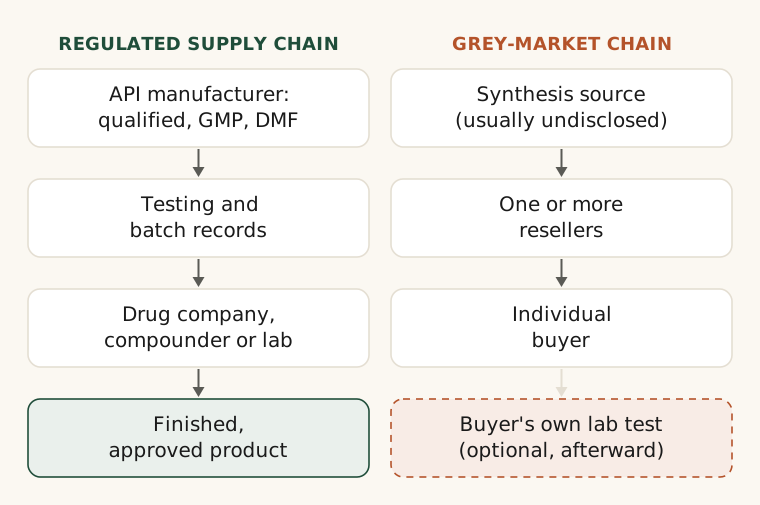
Supplier qualification. Before a drug company can use a given manufacturer's API, it has to qualify that manufacturer — auditing the facility, reviewing its quality systems, and confirming it can consistently produce material meeting a defined specification. This isn't a one-time check; qualified suppliers are subject to ongoing audits and requalification.
Current Good Manufacturing Practice (GMP or cGMP). FDA has adopted ICH Q7 as its guidance on GMP for active pharmaceutical ingredients; its stated aim is to help ensure APIs have the quality and purity they are represented to have. FDA's own compliance program includes cGMP inspections of API facilities to confirm compliance with the Federal Food, Drug, and Cosmetic Act. In practice, that means documented, validated manufacturing processes, in-process testing at defined steps, and traceable batch records — not just a final check on the finished material.
Drug Master Files (DMFs). A peptide API manufacturer can file a Drug Master File with the FDA — confidential, detailed documentation of a facility's manufacturing process, quality controls, and analytical methods for a specific drug substance. A Type II DMF specifically covers a drug substance, drug substance intermediate, or related material. The drug company that will use that API references the manufacturer's DMF in its own regulatory submission, without the manufacturer having to disclose its proprietary process details directly to a competitor. It's one of the main mechanisms that lets a specialized CDMO supply multiple drug companies while keeping its process confidential from each of them.
Ongoing testing and documentation. Each batch of API that moves through this chain comes with a certificate of analysis from the manufacturer, further testing by the receiving company, and a batch record that a regulator can inspect. This is the same core idea behind a lab report on a grey-market vial — testing what's actually in the material — but embedded in a mandatory, audited system rather than left to a buyer's own initiative.
From there, the API typically moves to a drug company's own facility, another CDMO for formulation, or a compounding pharmacy (for products or components legally permitted to be compounded) — each of which has its own qualification and documentation requirements before the finished product reaches a patient.
Research institutions sit in a related but separate lane. A university lab or a contract research organization ordering peptide for a study typically buys from a specialized research-chemical supplier or the same peptide manufacturers described above, often at a smaller scale and under a different set of purchase terms than a commercial drug company would use — a research-use purchase order, not a drug-manufacturing supply contract. That distinction matters because it's also the language grey-market sellers borrow: "for research use only" is a legitimate, common category, and it's also the exact phrase stamped on unregulated vials aimed at individual buyers who aren't running a study at all. The label is the same; the actual customer, paperwork, and end use are what differ.
It's also worth being clear about what "qualification" means in practice, because it's not a single form. A drug company's quality unit typically audits a prospective API supplier's facility on-site, reviews its standard operating procedures and validation data, confirms its analytical methods are suitable for the specific peptide in question, and then continues periodic requalification audits for as long as the relationship continues. A single failed or overdue audit can suspend a supplier relationship regardless of how good a given batch's certificate of analysis looks — the system is built around ongoing oversight of the manufacturer, not just a one-time check of the material.
Where "buy peptides wholesale" runs into a wall
If your actual question is "where do I find a supplier," this is a lab-data site, not a sourcing directory, so we're not going to point you to one — for legitimate wholesale supply or for the grey market.
What we can say, factually, about what legitimate wholesale peptide supply actually involves: it's a business-to-business transaction between a manufacturer and a qualified commercial customer — a drug company, a compounder operating within its legal scope, or a research institution — not a retail purchase. It requires the qualification, GMP compliance, and documentation described above on the seller's side, and typically requires the buyer to demonstrate its own legitimate use case and licensing. None of that is a checklist an individual can complete to buy peptide "wholesale" for personal use, and a seller who skips all of it isn't operating in that legitimate channel, whatever the listing claims — the same gap worth checking for in any grey-market seller's own unverifiable claims.
The grey-market chain, for contrast
The unregulated "research use only" peptide market — the tirzepatide, retatrutide, and BPC-157 vials this site publishes lab data on — runs through a much shorter and much less documented chain: a synthesis source, one or more resellers, and an individual buyer. There's no supplier qualification process, no mandatory GMP inspection, no DMF, and no regulator checking a batch record before it ships. Whatever quality assurance exists is whatever a buyer arranges independently, after the fact, by paying for their own lab test — which is the entire premise of this site. We go through that chain in detail, including where the raw material typically originates and why demand grew so fast, in what are grey market peptides.
The contrast is the whole point of this article: the legitimate chain is built around proving quality before material moves; the grey-market chain is built around a buyer checking for it afterward, if they bother to check at all. A lab report on a research vial — the kind of report our vendor ratings are built from — tells you what one vial measured on one day. It's not a substitute for the qualification and documentation system described above, and it was never meant to be; it's the only check that exists in a market that has none of that system built in.
What this means if you're trying to understand sourcing, not find a source
If you came here because you're curious how the legitimate pharmaceutical supply chain actually works, the short version is: qualified manufacturer, audited GMP compliance, documented batch records, and (often) an FDA-referenced Drug Master File, all before a drug company can put its name on the finished product. If you came here trying to find where to personally buy peptides, wholesale or otherwise, that's not something we help with. The practical move either way is to judge a seller on independently verified lab evidence rather than a listing's claims. See how to judge a peptide supplier for how to do that, and the live vendor ratings for what's actually been measured, vendor by vendor, from buyer-commissioned lab reports. Our methodology explains how those scores are built, and if you've had something tested yourself, you can submit the report.
This isn't legal advice. Regulatory terms above (GMP, cGMP, Drug Master Files) are described as the FDA's own guidance defines them, cited inline; nothing here is a claim about any specific company's current compliance status.
Frequently asked questions
Where do companies get their peptides from?
Pharmaceutical companies source peptide active ingredients from specialized contract manufacturers (CDMOs) such as Bachem, PolyPeptide Group, or CordenPharma, or manufacture some in-house, after a formal qualification process that includes auditing the facility, confirming GMP compliance, and reviewing documentation. Many API manufacturers also file a Drug Master File with the FDA, which the drug company references in its own regulatory submission. Every batch is tested and documented before it moves further down the chain.
Where do I buy peptides wholesale?
We don't provide sourcing help — this is a lab-data site, not a sourcing directory. What we can say factually is that legitimate wholesale peptide supply is a business-to-business transaction requiring manufacturer qualification, GMP compliance, and documentation on the seller's side, plus a demonstrated legitimate use case and licensing on the buyer's side. It isn't a retail process, and we don't name suppliers or walk through how to find one.
What is a Drug Master File?
A Drug Master File (DMF) is a confidential submission to the FDA containing detailed information about a facility's manufacturing process, quality controls, and analytical methods for a drug substance or related material. A Type II DMF covers a drug substance, its intermediates, or related materials specifically. A drug company can reference a manufacturer's DMF in its own FDA submission without the manufacturer disclosing its proprietary process directly to that company.
What does GMP mean for peptide manufacturing?
GMP, or current Good Manufacturing Practice, is the FDA's framework for ensuring that active pharmaceutical ingredients meet the quality and purity standards they claim. For peptide APIs, the FDA expects manufacturers to follow ICH Q7 guidance, and the agency's own compliance program includes GMP inspections of API facilities. In practice, it means validated processes, in-process testing, and traceable batch records, not just a check on the finished material.
Does a legitimate peptide supply chain include lab testing?
Yes, but embedded differently than in the grey market. A qualified API manufacturer provides a certificate of analysis with each batch, and the receiving company typically performs its own testing before use, all within an audited, regulator-inspectable system. That's a different structure from the grey market, where a buyer's own independently commissioned lab report is often the only check that exists at all.
How is the legitimate supply chain different from the grey market?
The legitimate chain requires supplier qualification, GMP compliance, and documentation before material moves, with an FDA-inspectable paper trail. The grey market — the research-labeled vials this site publishes lab data on — runs through a synthesis source, one or more resellers, and a buyer, with no mandatory qualification, inspection, or documentation, and whatever testing exists is arranged by the buyer afterward, if at all.
Can I ask VendorVerify where to source peptides?
No — we don't recommend sellers or provide sourcing steps, for legitimate wholesale supply or for research-labeled products. What we do is aggregate independently commissioned lab reports into per-vendor track records, so that if you're evaluating a specific seller, you can judge them by verified lab data rather than by a listing's own claims.