Peptide guides
What are KLOW and GLOW? The peptide blends explained
Two market nicknames for multi-peptide vials. Each ingredient has its own evidence story, but nobody has studied the combinations, and a blend makes each ingredient harder to verify. Here's the breakdown, plus what independent lab tests find in KLOW and GLOW.
For research use only. VendorVerify sells nothing and takes no money from vendors. No affiliate links, no coupon codes, no paid rankings. How scores work
Key facts
- KLOW and GLOW are vendor-made grey-market blend names, not compounds: GLOW is sold as BPC-157, TB-500 and GHK-Cu, and KLOW adds KPV to those three.
- No published study or registered clinical trial tests KLOW or GLOW; a September 29, 2026 Europe PMC and ClinicalTrials.gov search found none for the combination.
- In a 2026 Joint Diseases and Related Surgery study of 32 rats, BPC-157 plus TB-500 gave no additional tendon-healing benefit over either peptide alone.
- In July 2026, an FDA advisory committee recommended BPC-157, KPV and TB-500 for the compounding list, a non-binding vote that does not cover multi-ingredient research vials.
- VendorVerify's database holds 12 KLOW vials from 6 vendors and 6 GLOW vials from 2 vendors; 9 of the 9 KLOW vials with a fill measurement came in more than 5% over their 80 mg labeled total.
KLOW and GLOW are nicknames for vendor-made blends, not compounds. GLOW is sold as a mix of BPC-157, TB-500 and GHK-Cu; KLOW is the same three plus KPV. The names come from the grey market, and we found no journal article or regulator document that defines either one. Each ingredient has its own evidence, which ranges from rat studies to decades of skincare research, but we found no study of either blend, so what you get from the mix is simply unknown.
What KLOW and GLOW are
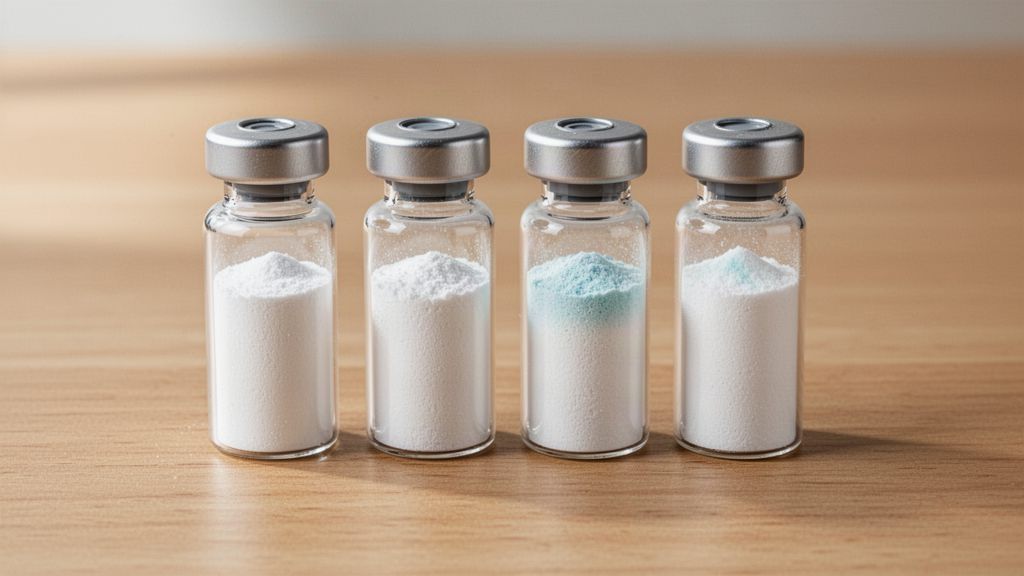
Vendors sell KLOW and GLOW as a single vial holding several peptides in a set ratio, promoted for tissue repair, skin quality and inflammation all at once. The pitch is convenience: instead of buying three or four separate vials, you buy one. The ratio between ingredients is chosen by whoever makes the blend, and nobody publishes the reasoning behind it, because there is no research behind it.
The names have no official definition. The composition above is how sellers describe them, and different sellers may use the labels for different mixes, so the ingredient list on a specific vial's certificate matters more than the name on the front.
Here is how each ingredient stands on its own. We cover them in depth in separate guides, so this is a summary that matches them.
The ingredients, graded
| Ingredient | In GLOW / KLOW | Best evidence | Our guide |
|---|---|---|---|
| BPC-157 | Both | Animal/lab only for healing claims; three small human studies, none a controlled efficacy trial | What is BPC-157? |
| TB-500 | Both | Animal/lab only for the fragment sold as TB-500; the human trials tested the full thymosin beta-4 protein, not the fragment | What is TB-500? |
| GHK-Cu | Both | Human trials for topical skincare; no published human data for injecting it | What is GHK-Cu? |
| KPV | KLOW only | Animal/lab only (mouse colitis models, human cells in a dish); no human trials | What is KPV? |
Read that table as four separate bets, not one. The strongest human evidence in the whole list belongs to GHK-Cu, and it is for a cream, not an injectable, so it says little about a blend sold for injection. The healing claims for BPC-157 and TB-500 rest on animal work. KPV has the thinnest base of all: mouse and cell studies only.
What the research shows about the blends
Nothing, as far as we can find. We searched Europe PMC on September 29, 2026 for papers mentioning BPC-157, TB-500 (or thymosin beta-4) and GHK-Cu together; the hits were 2025 and 2026 reviews and commentaries about peptides in general, and we found none reporting a study that gave that combination to animals or people. A ClinicalTrials.gov search for the same combination returned no registered studies, and a search for KLOW returned none either (ClinicalTrials.gov).
The closest thing we found is a 2026 rat study that tested BPC-157 and TB-500 alone and together after surgical repair of the Achilles tendon. TB-500 significantly improved maximum load to failure and tendon scores versus untreated controls, while BPC-157 showed better numbers that did not reach statistical significance for total scores, and the authors report that the combination did not confer additional benefits compared to either agent alone (Biçer et al., Joint Diseases and Related Surgery, 2026). The authors call it exploratory, it involved 32 rats and two of the four ingredients, and it is no evidence about people. It does show why "more peptides" is not automatically "more effect": when someone finally tested a pairing, it did not beat the single ingredients.
There is also no research on whether the ingredients interact when mixed in one vial, whether they stay stable together, or whether taking them at the same time changes how any of them behaves in the body. Those are open questions, not settled ones.
Side effects and risks
There is no safety data for either blend. The risks of each ingredient are unresolved for humans and are covered in the ingredient guides: BPC-157 and TB-500 have almost no controlled human safety data for the way they are used on the grey market, GHK-Cu has none for injection, and KPV has none for people at all.
Blends add two problems of their own. First, if you have a bad reaction, you cannot tell which ingredient caused it, and you are exposed to all of them at once. Second, four unstudied ingredients multiply the unknowns, because any of them could matter and their interactions are untested.
On the regulatory side, the ingredients are in different positions. At its July 23-24, 2026 meeting, an FDA advisory committee recommended BPC-157, KPV and TB-500, along with MOTS-c, Epitalon and Semax, for the list of substances licensed compounding pharmacies may use. That was a non-binding recommendation; the Secretary of Health and Human Services still has to formally approve any addition, and pharmacies cannot compound them until rulemaking is complete (NCPA, July 31, 2026). GHK-Cu was not on the committee's agenda (FDA, meeting page). Even if every recommendation were adopted, none of it would cover a multi-ingredient research vial.
Why a blend is harder to verify
This is the part where our data is most useful. With a single-ingredient vial, a lab report answers three simple questions: is the right compound in there, how pure is it, and how much is there compared with the label. With a blend, each of those questions has to be answered for every ingredient.
- Identity. The lab has to confirm each ingredient is present, not just that some peptide is.
- Amount. The label often gives a single total for the vial. The lab has to measure each ingredient separately to know whether one is short while another is heavy.
- Purity. One overall purity figure can hide a weak ingredient, because a strong peak from one component can dominate the number.
- Cause. If a vial comes back off-label, you can't tell which ingredient is responsible without a per-ingredient breakdown.
That is why lab reports on blends look different from the ones you are used to. In our data, on one KLOW vial the lab reported each ingredient separately, and on another it reported a single fill amount against the blend's labeled total. For more on reading these reports, see how to read a peptide COA.
What the lab tests show
Our database includes 12 KLOW vials from 6 vendors, from lab reports dated July 2025 through September 2026, and 6 GLOW vials from 2 vendors, from reports dated April 2025 through August 2025. These are small samples, and because blends are reported ingredient by ingredient, we are not stating failure counts or rates for either blend; that would be unreliable.
What we can report is what the labs measured. For KLOW, fill against the 80 mg labeled total was measured on 9 vials: 9 came in more than 5% over and 7 more than 20% over, with the median vial 32.0% over its label when the per-ingredient amounts are added up. As of October 1, 2026, purity had been reported on 4 KLOW vials, ranging from 99.5% to 99.8%, and on the seven vials more than 20% over, GHK-Cu was the heaviest ingredient, at roughly 65 to 77 mg. On the same date, endotoxin results on KLOW ran from about 1 EU per vial to about 880 EU per vial, plus one reported simply as a pass and one given per milligram. Endotoxin results depend on the test used and how it is reported, so see endotoxin in research peptides before reading much into a single number.
For GLOW, the two reports we held on October 1, 2026 gave no purity figure. One labeled its vials 50/10/10 (70 mg in total): the three vials measured about 16% over that total, with each of the three ingredients above its labeled amount. The other report gave no label amounts, and its lab measured TB-500 as the short 889 Da fragment rather than full thymosin beta-4, which shows how much the same name can hide. Its one endotoxin result was 0.516 EU.
A blend that looks reasonable in total can still be well off on individual ingredients, and a handful of reports says very little. Here is how the ranked vendors for KLOW look right now; a vendor needs five or more lab reports before it is ranked, so this table may be short or empty:
Highest-ranked KLOW vendors right now
Live from independent lab reports, mostly paid for by buyers. Only vendors with 5+ reports are ranked. Updates as new reports come in.
No vendor has enough lab reports to be ranked for KLOW yet. Every result so far is listed on the KLOW results page.
A strong record describes vials people tested, not a guarantee for yours. Test your own vial when you can.
All KLOW resultsBuying smarter
Check the KLOW results page and the GLOW results page for current data, and read it knowing how thin it is. If you are deciding between a blend and separate single-ingredient vials, the practical difference is that single vials give you a cleaner, more comparable lab result for each ingredient, and each one has its own record in our data (see BPC-157, TB-500 and GHK-Cu). A blend gives you convenience and a bigger question mark.
If you do buy a blend, make sure any report you rely on lists each ingredient's identity and measured amount separately, and treat a certificate that only gives one overall number as incomplete. Vendor-posted certificates deserve extra scrutiny; see fake peptide COAs. To get your own vial checked, how to get a peptide tested covers what to ask the lab for, and it is worth asking specifically for per-ingredient quantities on a blend.
If a report comes back with a fail, stop using that batch, tell anyone else who bought from the same run, bring the report to the vendor, and submit it to VendorVerify so the next buyer has more to go on. If you have results on a GLOW vial, we would especially like to see them, since GLOW reports are still scarce.
Database figures without a date update automatically from VendorVerify's lab results; dated figures are snapshots. This isn't medical advice. KLOW and GLOW are sold for research use only and neither blend has been evaluated by FDA for safety or effectiveness in humans.
Database figures in this article update automatically from the lab results on VendorVerify. Figures given with a date are snapshots from Sep 29, 2026. The vendor and peptide pages show the full, latest data.
Frequently asked questions
What is KLOW peptide?
KLOW is a vendor-made blend of four peptides: BPC-157, TB-500, GHK-Cu and KPV. The name is a market label, not an official or scientific one, and we found no study of the blend itself.
What is GLOW peptide?
GLOW is sold as a blend of BPC-157, TB-500 and GHK-Cu. It is the same mix as KLOW without KPV. Like KLOW, it is a market nickname with no published research on the combination.
What is the difference between KLOW and GLOW?
KLOW contains KPV in addition to the three ingredients in GLOW. Because the names are not standardized, different sellers may use them for different mixes, so check the ingredient list on the specific vial's report.
Does the KLOW or GLOW blend work?
Nobody knows, because neither blend has been studied. The ingredients have separate evidence, mostly from animal work, apart from GHK-Cu's skincare data. In the one rat study we found that tested BPC-157 and TB-500 together, the pair did not beat either alone.
Are KLOW and GLOW safe?
There is no safety data for either blend, and the individual ingredients have limited or no controlled human safety data for the way they are used on the grey market. A blend also makes it impossible to tell which ingredient caused a reaction.
Are KLOW and GLOW FDA-approved?
No. None of the ingredients is approved as a drug, and neither blend has been evaluated by FDA. In July 2026 an FDA advisory committee recommended BPC-157, KPV and TB-500 for a compounding list, but that is a non-binding recommendation, GHK-Cu was not on the agenda, and it would not cover a research-vial blend.
How can I tell what is really in a KLOW vial?
Get an independent lab report that lists each ingredient's identity and measured amount separately, not just one overall purity number. The lab reports we hold on KLOW show purity of 99.5% to 99.8% where it was reported, but most KLOW vials with a fill measurement came in well over their labeled total, and the sample is small.