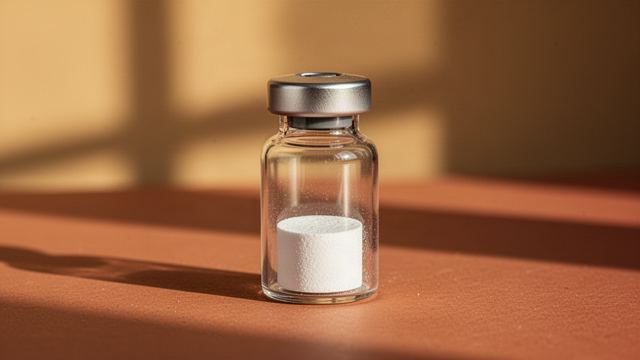
Peptide guides
What is Melanotan I (Afamelanotide)? What it does, benefits and what the evidence shows
A synthetic copy of the pigment-controlling hormone, and one of the few peptides in this series with an FDA label. The approved product is a clinician-placed implant for one rare condition, not a tanning drug. Here is how it differs from vials sold for tanning, and what the research shows.
For research use only. VendorVerify sells nothing and takes no money from vendors. No affiliate links, no coupon codes, no paid rankings. How scores work
Key facts
- Melanotan I is the research name for afamelanotide, a 13-amino-acid synthetic analogue of alpha-MSH that binds predominantly to the MC1-R skin pigment receptor.
- FDA approved afamelanotide in 2019 as the Scenesse implant for adults with erythropoietic protoporphyria and a history of phototoxic reactions, not for tanning.
- In two randomized placebo-controlled trials of 74 European and 94 US patients with EPP, published in NEJM in 2015, afamelanotide lengthened pain-free time in direct sunlight.
- In the FDA label's three vehicle-controlled trials of 244 adults with EPP, implant-site reactions occurred in 21% of Scenesse patients versus 10% on placebo.
- In a 2015 JAMA Dermatology trial of 55 people with vitiligo, afamelanotide implants plus narrowband UVB reached 48.64% repigmentation at day 168 versus 33.26% for light alone.
- As of September 29, 2026, VendorVerify's database holds three Melanotan I vials with purity from 99.72% to 99.85%, and none met its failure definition.
Melanotan I (MT-I) is the research name for afamelanotide, a synthetic copy of alpha-melanocyte-stimulating hormone (alpha-MSH), the signal that makes skin produce dark pigment. It is one of the few compounds in this series with an FDA approval: since 2019 it has been sold as Scenesse, a small implant placed under the skin by a trained clinician, indicated to increase pain-free light exposure in adults with a history of phototoxic reactions from a rare inherited disorder called erythropoietic protoporphyria (EPP). The approval is not for tanning, and the vials sold online as Melanotan I are a different product with no label, no clinical oversight and no matching safety monitoring.
What Melanotan I is and how it works
Afamelanotide is a 13-amino-acid straight-chain peptide. The FDA label describes it as a synthetic analogue of alpha-MSH that acts as a melanocortin receptor agonist, binding predominantly to the skin pigment receptor MC1-R, and says it increases production of eumelanin (the dark pigment) in skin independently of exposure to sunlight or artificial UV (Scenesse prescribing information, DailyMed). Early human tanning studies used the same molecule under its research name, [Nle4-D-Phe7]-alpha-MSH (Dorr et al., Photochemistry and Photobiology, 2000).
Two things make it a different animal from its sibling Melanotan II. It acts mainly on the skin receptor rather than across several melanocortin receptors, and it is the version that went through full drug development. Our Melanotan II guide covers the ring-shaped peptide with the sexual effects and the safety reports; the approved bremelanotide relative is in the PT-141 guide. One curiosity from the label: the chain ends in the sequence Lys-Pro-Val, the same three amino acids that make up the small fragment covered in our KPV guide.
What is actually approved
The DailyMed record for Scenesse (label version dated May 2026, Clinuvel Inc.) lists one indication: to increase pain-free light exposure in adult patients with a history of phototoxic reactions from EPP, with initial US approval in 2019. The product is a controlled-release implant, a small rod of the peptide mixed with a biodegradable polymer, and the label says it must be administered by a health care professional who is proficient in the implantation procedure and has completed the manufacturer's training program. Safety and effectiveness in children have not been established (Scenesse prescribing information, DailyMed).
The European Union also authorized afamelanotide for EPP, as a condition of which regulators required a post-authorization safety study and a disease registry (Homey et al., Photodermatology, Photoimmunology & Photomedicine, 2025).
Approved implant versus grey-market vials
| Scenesse (approved) | Vials sold as Melanotan I | |
|---|---|---|
| Who it is for | Adults with EPP and phototoxic reactions | Anyone seeking a tan |
| Form | Sterile, biodegradable controlled-release implant | Research-labeled peptide, unlicensed |
| Who gives it | A trained health care professional | Not overseen |
| Skin monitoring | Full-body skin exams are part of the label | None built in |
| Regulatory review | FDA approval based on vehicle-controlled trials | None |
The gap is not just paperwork. The implant is a licensed, sterile product, its safety was studied in trials with defined monitoring, and the label tells prescribers to watch skin lesions. A vial sold online may contain what it says or something else, and no clinician is looking at your moles. We cannot say what any particular vial contains; that is what lab reports are for.
What people use it for
| Claimed benefit | Evidence | Source |
|---|---|---|
| Reducing phototoxic reactions and pain in EPP (prescription implant) | Approved use | Scenesse label, DailyMed; Langendonk et al., NEJM, 2015 |
| Skin darkening without UV exposure | Early human data | Dorr et al., 2000 |
| Repigmentation of vitiligo alongside light therapy | Human trials | Lim et al., JAMA Dermatology, 2015 |
| Reducing UV-induced skin redness | Early human data | Griffin et al., Photochemical & Photobiological Sciences, 2026 |
| A safer "sunless tan" that protects against skin cancer | Anecdotal | none |
What the research actually shows
EPP: the approved use
EPP makes light cause severe burning pain. In two multicenter, randomized, double-blind, placebo-controlled trials (74 patients in the European Union and 94 in the United States), pain-free time in direct sunlight was longer with afamelanotide: a median of 69.4 hours versus 40.8 in the US trial and 6.0 versus 0.8 in the EU trial, with fewer phototoxic reactions in the EU trial and better quality of life in both; adverse events were mostly mild (Langendonk et al., New England Journal of Medicine, 2015). The FDA label reports the same two studies with slightly different medians for the US trial, 64.1 hours versus 40.5 (Scenesse label).
Those are meaningful gains for a small population with an inherited disease and a markedly reduced quality of life. They are not results in healthy people. In a German observational safety study of 200 patients treated under the European label, quality of life rose significantly from baseline and 91.0% of patients who started treatment were still on it, with a safety profile in line with the trials (Homey et al., 2025).
Tanning in healthy volunteers
In seven healthy volunteers with tanning-capable skin types, a short course of MT-I under the skin darkened the face, neck and forearm, and skin biopsies showed a large rise in eumelanin with no significant change in pheomelanin (Dorr et al., 2000). This is where the "sunless tan" claim comes from. It is a real effect, from a seven-person study, in a controlled research setting.
Vitiligo
In a randomized multicenter trial of 55 people with nonsegmental vitiligo, afamelanotide implants plus narrowband UVB light produced faster and greater repigmentation than light alone (48.64% versus 33.26% repigmentation at day 168), with the effect more noticeable in darker skin types; nausea and minor infections were among adverse events noted in the combination group (Lim et al., JAMA Dermatology, 2015). A larger Phase 3 comparison from the same sponsor is registered on ClinicalTrials.gov as active but no longer recruiting, with an estimated completion of June 2026 (NCT06109649). In a July 2026 announcement to the Australian stock exchange, the sponsor said the study has enrolled 210 patients and that topline results are expected in December 2026 (Clinuvel ASX announcement, July 2026). No results are published yet, so vitiligo remains an unapproved use.
UV redness and "protection"
A small exploratory study in nine healthy adults found that after an afamelanotide implant, UV-induced skin redness was lower (Griffin et al., 2026). Nine people over a short window is a hypothesis-generator. We found no study showing that an MT-I tan protects against skin cancer, and a tan is not a substitute for that evidence.
Side effects and risks
Label safety data. In three vehicle-controlled trials of 244 adults with EPP, the most common reactions were implant-site reactions (21% on Scenesse versus 10% on placebo), nausea (19% versus 14%), oropharyngeal pain, cough, fatigue, dizziness, skin hyperpigmentation (4% versus 0%), sleepiness and melanocytic nevus (4% versus 2%). Serious hypersensitivity reactions, including anaphylaxis, have been reported after approval (Scenesse label).
Moles. The label warns that afamelanotide may darken existing nevi and freckles because of its pharmacologic effect, and recommends regular full-body skin examinations to monitor pigmented lesions (Scenesse label). In a study of 15 EPP patients whose 103 moles were examined under dermoscopy, changes were reversible and none suggested malignancy, and no new moles appeared (Arisi et al., 2021). That is reassuring for supervised use with lesion checks; it is not a study of unsupervised use.
Unregulated use. A 2017 dermatology review said that afamelanotide has been thoroughly tested and deemed safe for its approved indication, but that illegal melanotans are likely risky for several reasons: uncertain preparation, administration and dosage, and case reports linking unregulated use of both melanotan I and II to changes in existing moles and new atypical nevi. It counted four case reports of melanomas emerging from existing moles during or shortly after melanotan use, with conclusive evidence of a link lacking (Habbema et al., International Journal of Dermatology, 2017). Many of those reports do not specify which melanotan was used, and the more severe reports we found (priapism, muscle and kidney injury) concern Melanotan II, not MT-I; see the MT-II guide.
Pregnancy and children. The label says there are no data in pregnant women and that pediatric safety and effectiveness have not been established.
What the lab tests show
As of September 29, 2026, VendorVerify's database has three Melanotan I vials from two vendors, with reports dated March 2025, April 2025 and August 2026. Purity ranged from 99.72% to 99.85%, and all three measured about 5% to 8% over their labelled amount. One vial has an endotoxin result, a pass. None of the three met our failure definition (empty, under 95% pure, more than 20% under label or more than 50% over). Three vials say nothing about the market or about any vendor, and purity and amount do not tell you about sterility, or about how the product would behave in your body. Compound-level results are on the Melanotan I results page, and you can add to them by submitting a report.
Because we don't have enough lab data on this compound to rank vendors for it, here are the highest-ranked vendors across all compounds right now. A vendor's overall record is a signal, not a guarantee for a compound they have never had tested.
Highest-ranked peptide vendors right now
Live from independent lab reports, mostly paid for by buyers. Only vendors with 5+ reports are ranked. Updates as new reports come in.
| # | Vendor | Verdict | Score | Failed vials | Lab reports | Dose vs label |
|---|---|---|---|---|---|---|
| 1 | BFF/AMO | Above market | 96.7 | 0.7% | 185 | +2.9% |
| 2 | ZLZ | Above market | 91.8 | 0.0% | 14 | +7.2% |
| 3 | QST | Above market | 91.0 | 0.0% | 13 | +6.9% |
| 4 | Uther | Above market | 90.9 | 0.0% | 45 | +10.2% |
| 5 | TCI | Above market | 90.1 | 0.0% | 72 | +9.3% |
A strong record describes vials people tested, not a guarantee for yours. Test your own vial when you can.
Full vendor ratingsBuying smarter
With only three vials on file, lean on the general checks. Look at each vendor's full record and how many reports sit behind the score. Treat a vendor-posted COA as a starting point (how to read a peptide COA, fake peptide COAs). Paying for identity, purity and quantity testing on your own vial is worth considering, and endotoxin testing matters for anything injected; how to get a peptide tested walks through it. Underdosed peptides explains why measured amounts and labels often differ.
If a report comes back with a fail, stop using that batch, tell anyone who bought from the same run, bring the report to the vendor, and submit it to VendorVerify. If you have EPP or another photosensitivity disorder, the approved product is prescribed through specialist clinics, which is a different route from anything discussed above. More reading: Melanotan II, PT-141, and the peptide hub.
Database figures are from VendorVerify as of September 29, 2026. This isn't medical advice; afamelanotide is approved only as the Scenesse implant for one condition, and vials sold as Melanotan I are unregulated research chemicals.
Figures in this article come from the lab results on VendorVerify as of Sep 29, 2026. The vendor and peptide pages always show the latest numbers.
Frequently asked questions
What does Melanotan I do?
It mimics alpha-MSH and stimulates skin cells to make dark pigment (eumelanin). In its approved form, the Scenesse implant, that helps adults with the rare disorder EPP tolerate light with less pain. In small studies of healthy volunteers it also produced a tan without UV exposure.
What are the benefits of Melanotan I?
For EPP, two randomized trials found longer pain-free time in direct sunlight and better quality of life. For vitiligo, one trial of 55 people found faster and greater repigmentation when combined with light therapy, but that use is not approved. The tanning benefit rests on a seven-person study.
Is Melanotan I the same as afamelanotide?
Yes. Afamelanotide is the drug name for Melanotan I, the peptide [Nle4-D-Phe7]-alpha-MSH. The approved product is the Scenesse implant, made and regulated as a medicine. Vials sold online under the Melanotan I name are unlicensed and not the approved product.
Is Melanotan I FDA-approved?
Yes, but only as Scenesse, an implant placed by a trained clinician, for increasing pain-free light exposure in adults with EPP. FDA approved it in 2019. It is not approved for tanning or vitiligo.
Is Melanotan I safe?
For the approved implant in EPP, the label lists implant-site reactions, nausea, darkening of moles and rare serious hypersensitivity, and calls for regular skin examinations. Unregulated melanotan use has been linked in case reports to atypical moles and melanoma, though a review said conclusive evidence is lacking.
What is the difference between Melanotan I and Melanotan II?
Melanotan I is a longer straight-chain peptide acting mainly on the skin pigment receptor, and it is approved as Scenesse for EPP. Melanotan II is a ring-shaped peptide acting on several melanocortin receptors, is not approved, and also affects erections and desire. See our [Melanotan II guide](/blog/what-is-melanotan-2).
Does Melanotan I cause skin cancer?
No study has shown that. The label says afamelanotide can darken existing moles and advises skin checks. In a small study of EPP patients, mole changes were reversible and none suggested malignancy. Case reports of melanoma after unregulated melanotan use exist, but a 2017 review said proof of a link is lacking.